The world’s eager embrace of Korean cool is now in India too. From K-pop to K-drama, Kimchi to k-beauty , Indian youngsters just cant get enough of Korea. Indians seem to have taken a liking for Korean flavors.
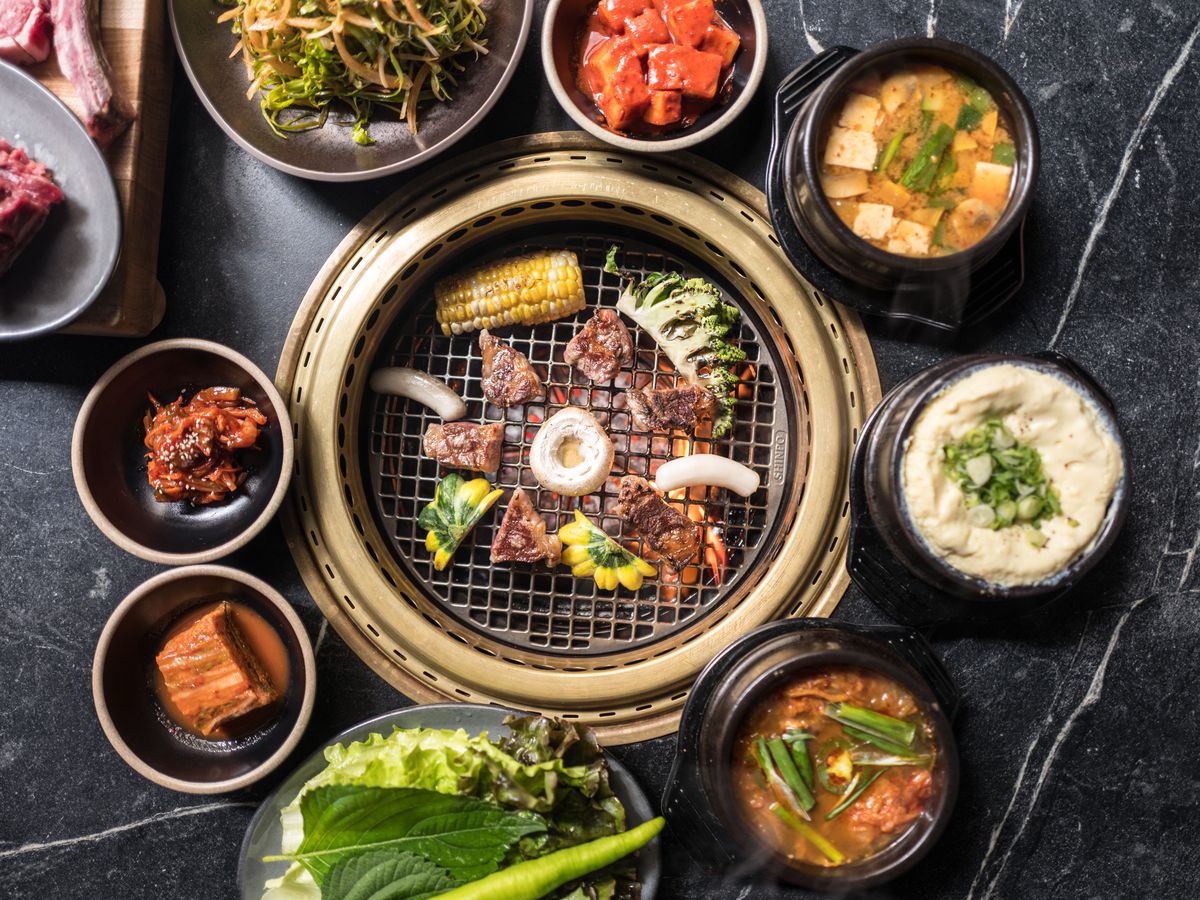
Unlike many other cuisines , Korean food isn’t about living your life under a rock, you are going to have to pull up a seat at a communal table, rest your knees on the floor and maybe even engage in a chopstick war so you grab the last piece of gridiron at the center of your table, you are going to get pickled vegetables in your teeth, spicy stew trickling down your chin and hearty flavors rolling around in your mouth.
Most Korean restaurants in India would typically do a Cheops ( five or seven side dishes). Dessert is not served after a meal , unlike in other countries.
The top dishes that you must try either in India or during your travel overseas
1)Kimchi
Kimchi , a staple in Korean cuisine, is a famous traditional side dish of salted and fermented vegetables, made with a widely varying selection of seasonings including garlic, ginger, scallions etc. There are hundreds of varieties of Kimchi made with different vegetables as the main ingredients. The most famous meal in this category is the cabbage Kimchi (Baechu kimchi). It is even served at chinese restaurants in India. It consists of cabbage, white raddish, red pepper powder, green onion, garlic and other seasonings.
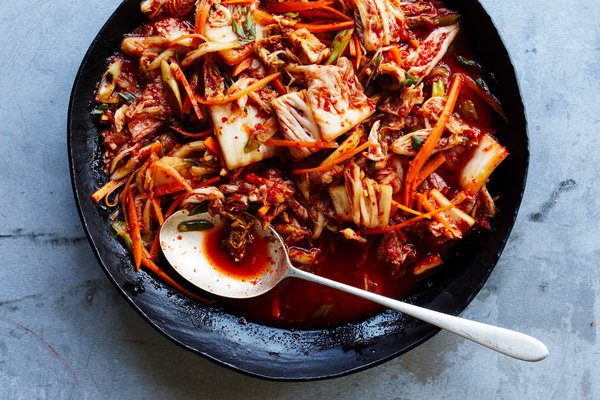
It is the cornerstone of Korean cooking.
Ingredients of kimchi
- 1 kg cabbage
- 1 tbsp salt
- 2 tbsp spring onions
- 1 tbsp garlic
- 1 tbsp ginger
- 1 cup of white vinegar and soya sauce
- 1/2 tsp sugar
- Sesame oil
Kim’s veg kimchi and mama instant noodles are some ready made products of kimchi.
2)Bibimbap
Bibimbap meaning “mixed rice” , is a Korean rice dish.It is served as a bowl of warm white rice topped with seasonings or kimchi and soy sauce. A raw egg or fried egg and sliced meat are common additions. The ingredients are mixed together with a few drops of a gochujang-spicy red pepper taste and sesame oil. The dish was listed at the number 40 on the world’s 50 most delicious foods readers compiled by CNN Travel. Each spoonful has a different taste.
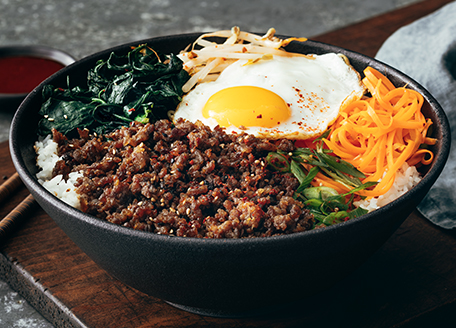
Michael Jackson put this dish on the global map after a trip to south Korea. Along with kimchi ,it takes its place among the favourite foods of korean food. The meal provides unique nutrition and flavor fused with attractive colors due to its rich ingredients. Furthermore,the ingredients have low calorie content,hence offer a healthy diet. By harmonizing together various ingredients , bibimbap emerges as a unique meal symbolizes the harmony and balances in the Korean culture.
There are different types of bibimbap like Rose bibimbap, Sprout bibimbap, Wild vegetable bibimbap, Raw fish bibimbap, Hot stone pot bibimbap etc.
Ingredients of bibimbap
- 1 English cucumber
- 1/4 cup gochujang (hot pepper paste)
- 1 bunch fresh spinach
- 1 tablespoon soy sauce
- 2 carrots
- 1 clove garlic
- 1 tsp olive oil
- 4 large eggs
- 4 cups cooked white rice
- 4 tsp sesame oil
- 1 tsp sesame seeds
Bibimbap ingredients are rich in symbolism. Black or dark color ingredients like mushrooms and seaweed represent the North. Red or orange ingredients like carrots and chilli represents the South. Green ingredients like cucumber and spinach represent the East. White ingredients like Radish,rice represents the west. Yellow ingredients like egg yolk,pumpkin represents the center.
3)Japchae (Glass noddles)
Japchae is a sweet and savory dish of stir-fried glass noodles and vegetables that is popular in Korean cuisine. Japchae is typically prepared with dangmyeon, a type of cellophane noodles made from sweet potatoes. Once a royal dish ,it is now often served on special ocasions , such as birthdays and weddings. It is also popular for feeding crowds at parties, banquets etc due to ease of bulk preparation and serving flexibility. It is commonly served as a side dish ,though it may also be a main dish.
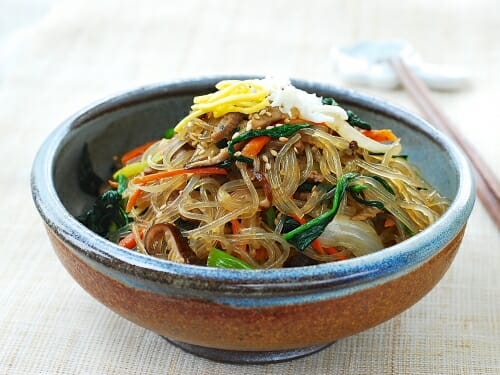
This is arguably Korea’s most popular noodle dish.
Varieties of Japchae–
- Gochu-japchae -made with shredded green pepper and vegetables.
- Buchu-japchae -made with garlic chives.
- Kongnamul-japchae -made with soybean sprouts.
- Haemul-japchae -made with seafood and vegetables.
- Beosot-japchae -made with mushrooms
- Gungjung-japchae -made with high grade ingredients and royal vegetables.
- Gyeoja-chae
- wolgwa-chae -made with oriental pickling melon, beef, vegetables.
Japchae is light,easy and a refreshing change from the usual dinner menu.It can be made in both vegetarian and non-vegetarian versions.
Ingredients of Japchae
- 3 tbsp soy sauce
- 1/2 tbsp white sugar
- 2 tbsp sesame oil
- 2 tsp minced garlic
- 8 ounces sweet potato noodles
- 4 ounces lean beef,cut into 2-inch long strips(optional)
- 6 ounces fresh spinach
- salt and ground black pepper to taste
- 1 tbsp vegetable oil
- 1 small sweet onion,thinly sliced
- 1 small carrot,cut into match sticks.
It is prepped in just 30 minutes.
4)Gimbap/Kimbap (seaweed Rice roll)
Gimbap is a Korean dish made from cooked rice and other ingredients that are rolled in gim (seaweed) and served in bite-sized slices.This dish is often part of a packed meal to be eaten at picnics and outdoor events and can be served a light lunch along with kimchi and yellow radish. Gimbap is easy to eat and is good to eat outside because the bowl does not get dirty even after eating all the gimbap.It is therefore a convenient food beacuse of it’s portability.It is usually well wrapped with aluminium foil and does not have any liquid ingredients.
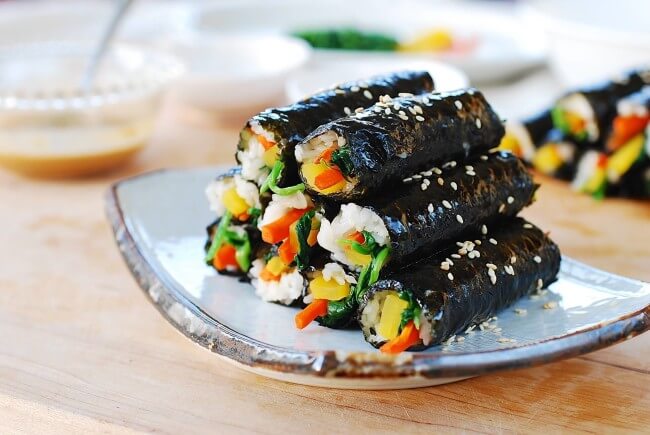
Gimbap has two conflicting versions of the modern form of gimbap.Some say it was derived from norikami,a japanese sushi variant and others say the food was developed from the local tradition bap (rice) and side dishes in gim.
Varieties of Gimbap–
- Chungmu-gimbap – The dish features thinner rolls with unseasoned surface and only rice as filler ingredient.
- Mayak-gimbap – Mayak translates to “drug” because of it’s addictive flavour. Small gimbap filled with carrots, spinach and raddish, sprinkled with sesame seeds.
- Samgak-gimbap – Literally”triangle gimbap”. This variety is similar to japanese onigiri.
- Nude gimbap – Unlike ordinary gimbap, the ingredients go inwards and the rice comes out and covers the entire area. It is similar to japanese style rolls, but uses ingredients used in Korean style kimbap.
Ingredients of Kimbap–
- 2 cups uncooked short grain rice
- 1 tbsp sesame oil
- salt to taste, about 1/2 tsp.
- 1 bunch spinach, about 8 ounces
- 5 yellow pickled radish, 1/2 inch thick strips.
- 2 eggs
- 5 gimbap gim
- 1 tsp soy sauce
- 1/2 tsp sugar
- 1 sheet fish cake-eomuk
Use a sharp knife for cutting your rolls and store your sliced gimbap in an airtight container.
5)Bingsu (Patbinsu)
Patbinsu literally means “red beans shaved ice” is a popular Korean shaved ice dessert . It is made from fine flavours shaved iced, such as milk, chocolate, yogurt, with sweet toppings that may include fruit, condensed milk, fruit syrup, cocktail and red beans. Bingsu is very popular especially during summer in Korea.
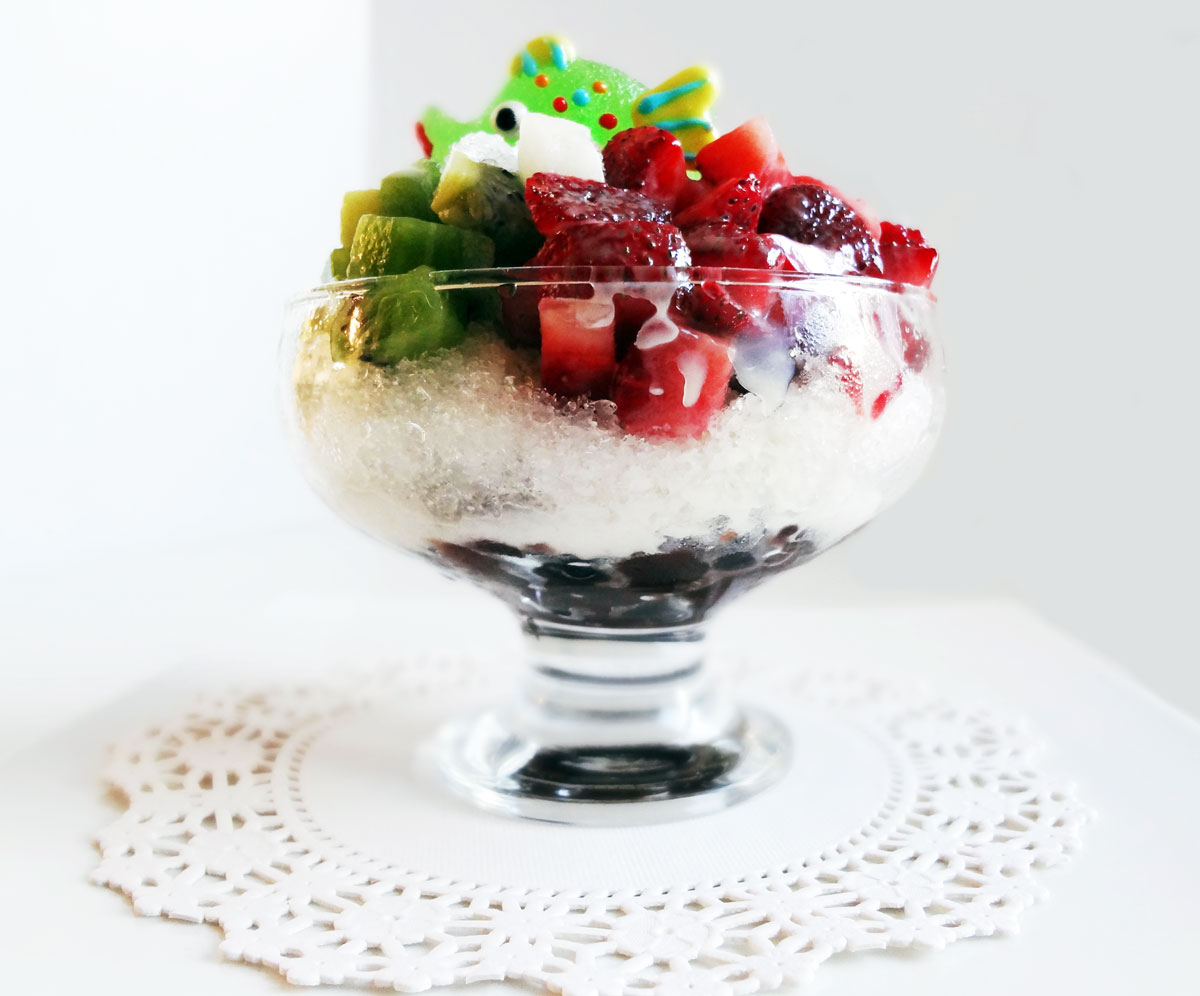
The early forms of bingsu consisted of shaved ice and two or three ingredients . The earliest forms existed during the Joseon Dynasty.Government records show that officials sharing crushed ice topped with various fruits.The modern forms of patbingsu are reputed to have originated during the period of Korea under Japanese rule,which led to the inclusion of ingredients such as fruits, nuts, cereal, syrups, whipped cream and ice cream.
There are variety of patbingsu types and flavours. Many bingsu do not necessarily follow tradition and some do not include red bean paste.Some popular varieties are Nokchu-bingsu (green tea bingsu), Ttalgi-bingsu (strawberry bingsu), choko-bingsu (chocolate bingsu), kiwi bingsu,mango bingsu, Injeoli bingsu (milk bingsu) etc.It can be found at the Ice frost Dessert Cafe at carter road, Bandra.This cafe is the maiden Indian venture of Ice Frost Dessert Cafe originally from Thailand.
Ingredients to make Injeoli bingsu
- 1 cup milk
- 2 tbsp sweetened condensed milk
- 2 scoop sweetened red bean paste(1 scoop per serving )
- 2-3 pieces Injeoli (korean glutinous rice cakes coated with roasted soybean powder)- cut into thumbnail size pieces.
- 2 tbsp mini mochi rice cakes (1 tbsp per serving)
- 4 tsp(or more)Korean multi grain powder (Misutgaru)
- 4 tsp (or more) natural alomond flakes (2 tsp per serving)
6)Pajeon
Pajeon is a variety of jeon with scallion as its prominent ingredient,as pa means scallion. It is a korean dish made from a batter of eggs , wheat flour, rice flour, scallions and often other ingredients depending on variety. Beef, pork, kimchi,seafood are mostly used.Pajeon is usually recognizable by the highly visible scallions. It is similar to a Chinese scallion pancake in appearance but is dense in texture and not made of dough.
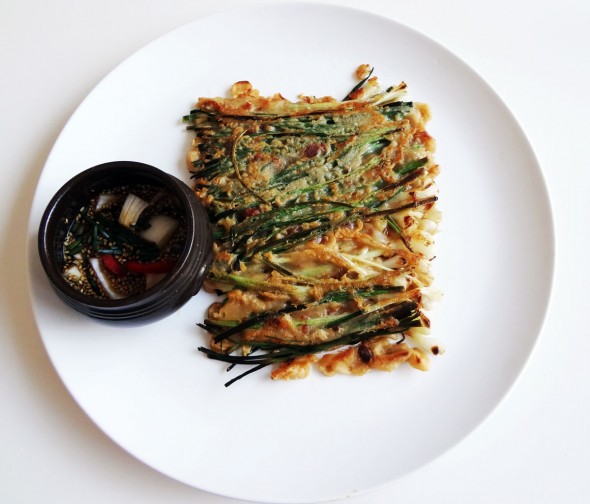
Varieties of pajeon–
- Some varieties of pajeon , with the shape of scallions preserved as in dongnae pajeon are typical jeon.
- Some other varieties , with the scallions cut and mixed in to the batter are closer to buchimgae.
- Dongrae pajeon– It is named after Dongraesung, a former forress in the Joseon Dynasty. Dongrae was a prominent battlefield during Imjin war and legends says the people threw scallions on the invading Japanese soldiers. Dongrae pajeon was made in honor of the victory. Dongre pajeon is usually made from a batter of rice flour, eggs and gochujang.The dish was also presented at the king’s table. Beef, soft scallions, clams, oysters, shrimp and other seafood are added.
- Seafood Pajeon– In korean , a seafood pajeon is called haemul pajeon. Various sefood are used in the batter and toppings such as ousters, shrimp, squid, clams, etc.
It is amde by placing scallions parallely on a hot pan with vegetable oil,pan frying them,then ladling onto them the batter made by mixing whaet flour,water,soybean paste and sugar. The pancake is turned over when the bottom holds together and is golden brown. It is usually served with a dipping sauce mad of soy sauce.
Ingredients to make Pajeon
- 2 cup Korean pancake mix
- 1/4 cup tempura flour
- 1/4 cup rice flour
- 2 and 1/2cup icy cold water
- 5 large beaten egg(1 egg per pancake)
- 250g calamari rings
- 250g medium sized prawns,un-shell and clean properly.
- 14 stalks green onion,cleaned and cut length
- 1 red chilli,thinly sliced diagonally
- Some vegetable cooking oil.
7)Chimaek
Chimaek is a pairing of fried chicken and beer,served as anju in the evening in many south Korean restaurants. From the roasted chicken that appeared in the early 1960s to the spicy chicken that was adapted to meet Korean tastes, South Korea has imported and developed a growing variety of chicken dishes. While chicken was gaining popularity,a new draft beer which appeared in the 1970s was also becoming very popular ,and it became common for the two to be combined as a single menu item.Until fried chicken came to Korea,chicken was only cooked in the form of baeksuk,a chicken stew. There are many theories on how fried chicken was introduced to Korea, but it most likely spread from the U.S.military to nearby base towns.
The word chicken and beer were not used in conjunction until 2002 with Korea-Japan World cup.
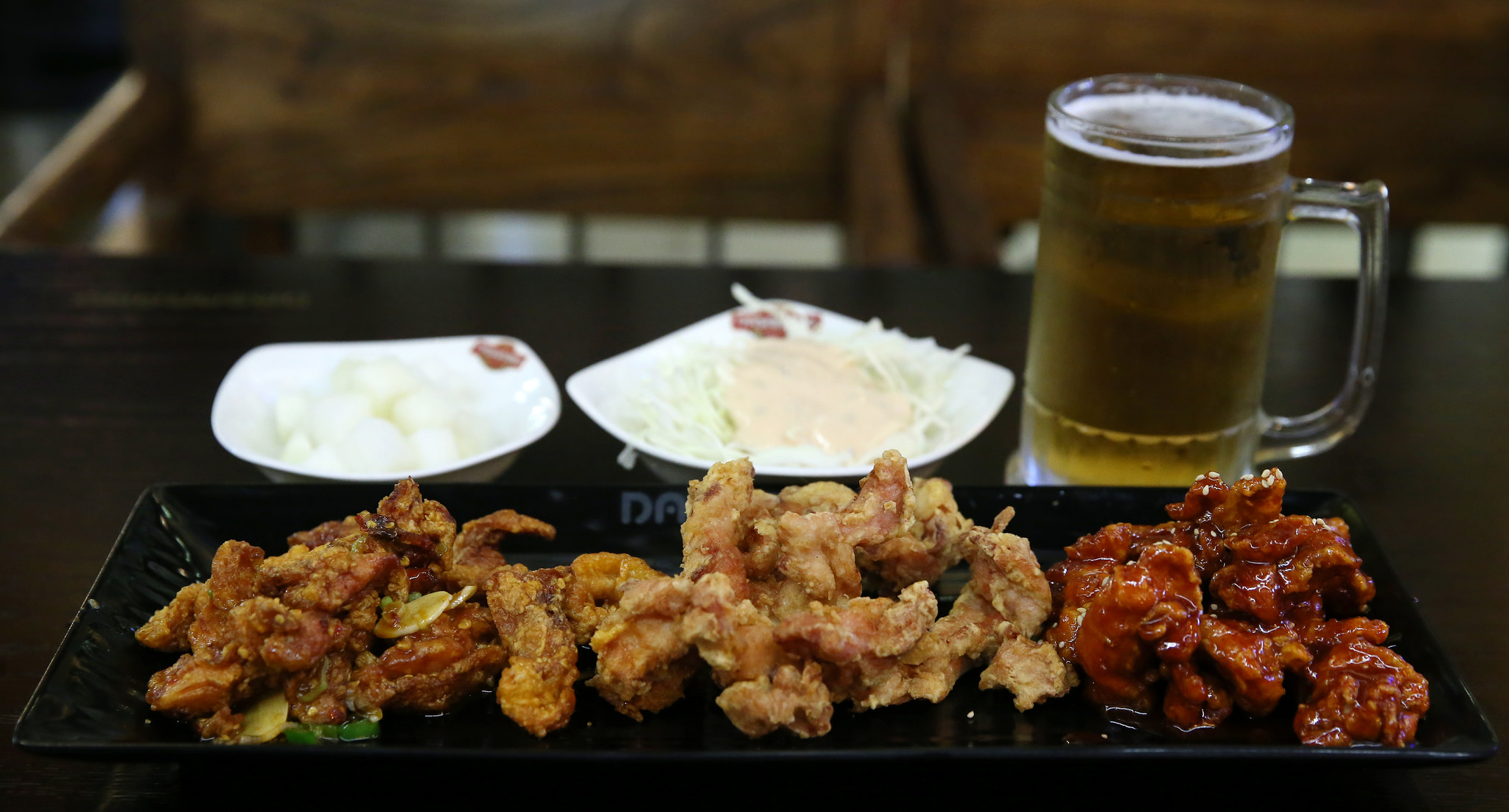
Today,fried chicken is one of the most popular dishes in Korea. It is so popular that Koreans created the word Chineunim , which is a compound word of chicken and god (Haneunium) in Korean.
Ingredients to make Chimaek–
- 3 pounds whole chicken , cut into pieces or chicken wings, rinsed.
- 2 tbsp rice wine.
- 2 tsp minced ginger
- 1 tsp fine sea salt
- 1/2 tsp ground black pepper
- 1 cup potato starch or corn starch
- some cooking oil for deep frying
- 3 tbsp tomato sauce
- 2 tbsp gochujang (Korean chilli paste)
- 1/4 cup honey
- 1/4 cup brown sugar
- 2 tbsp soy sauce
- 2 tbsp minced garlic
- 1 tbsp sesame oil
8)Tteok -bokki
Tteok-bokki is a popular Korean food made from small sized garae-tteok (long white,cylinder shaped rice cakes)or commonly tteok-bokki-tteok (tteok bokki rice cakes). Eomuk (fish cakes),boiled eggs and scallions are some of the most commonly added ingredients.It can be seasoned by either spicy gochujang or non-spicy ganjang based sauce.
The first record on tteok-bokki appears in a 19th century cookbook.The royal court version was made from white tteok,sesame oil,soy sauce,pine nuts,scalllions and toasted sesame seeds .,while the savory,soy sauce -based tteok bokki was amde in the head house of Papyeong Yun clan,where good quality soy sauce was brewed.
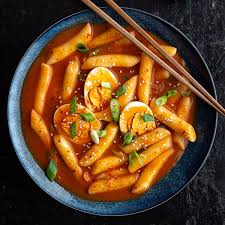
Rice tteok gained in as the South Korean economy developed ,and various versions of the dish have proliferated there and around the world.As it was a folksy food for working class people,wheat tteok was often substituted for rice.
Varieties of Tteok bokki–
- Curry tteok bokki is roasted by yellow Korean style curry.It uses powder which includes a lot of turmeric component.
- Cream tteok bokki is made with the idea of cream pasta.Cream and bacon are used.
- Jeukseok tteok bokki has a variety of add ons such as vegetables ,dumplings and ramyeon noodles.It is usually a meal rather than a snack.
- Galbi-tteok bokki uses short ribs as ingredient.
- Haemul-tteokbokki uses seafood as a sub ingredient.
Ingredients to make Tteok- bokki
- 350g Korean rice cakes
- 150g Korean fish cakes ,rinsed over hot water.
- 2 cups Korean soup stock
- 60g onion,thinly sliced.
- 3 tbsp gochujang
- 1 1/2 tbsp raw sugar
- 1 tbsp soy sauce
- 1 tsp minced garlic
- 1 tsp gochugaru (Korean chilli flakes)
So , above mentioned dishes are some of the most famous dishes of Korean cuisine. Some of the other beloved Korean dishes are Jjajangmyeon, Samgyeopsal, Soft Tofu stew, Hotpot Mixed Rice , Steamed mandu dumplings, Noodles in Ice soup, Kimchi fried rice, Mung bean Pancake, Tornado Potatoes etc.
Metro cities with large expat communities and a few consulates sometimes have charity events where the foreigners present their foods to the locals. Chennai’s was called international Night in the 90s. The Koreans in Chennai at that time were a small community, mostly traders. Like all the Korean restaurants were to come up since in Chennai, they were always surprised to see Indians. Korean restaurants were big on beef, which they think Indians won’t like and there maybe discreet supply of Shoju, that clear spirit that Koreans drink so much. But if you persist you can get excellent pajeon, kimchi, stews etc.
Korea House closed years back,but others took its place. Their names and locations have changed over the years ,but Chennai usually has at least three Korean restaurants running,of which InSeoul is the most permanent. Other Korean restaurants have come up across India, in Delhi and Gurgaon, Banglore and Pune. They follow Korean companies and students, which is why Mumbai, with no major Korean corporate presence , has no formal Korean restaurant.
Korean food may now be the foreign cuisine with the most number of really authentic restaurants in India- meaning no Punjabi-Chinese, Gujju – Italian ,Mexican-Marwari , Japanese-Jain dishes,but food that you get in Korea. Yet Korean food gets overlooked when people talk about foreign food in India. It is an interesting irony that Manchuria, which lent its name and nothing else to Chicken Manchurian , the defining dish of Indofusion , is relatedly close to Korea and parts of it were actually past of ancient Korean Kingdoms.
Origin
Best way to understand Korean food is through its geography and history.Korea is a mountainous peninsula, the sea on each side gives different seafood. But as much as Korea’s geography, it is its brutal history that created its food. Caught between China and Japan, Korea was repeatedly invaded by both, along with others like the Mongols, Manchus and later western colonial powers. All these invasions and occupations bought new foods to Korea, like tofu from China, but they also meant huge hardship for ordinary Koreans , with regular food supplies being disrupted and stolen. As a result for survival Koreans had to eat a huge variety of plants and grains and in time became a regular part of food.
The use of beef and the fact that even vegetable dishes have seafood element to them, might limit their appeal. But the food is strongly flavoured in ways that Indians can appreciate more than with Chinese and Japanese foods. It may take some time before food really becomes cool in India as is happening in the west, but at least India’s Korean restaurants give people a chance to try.
Reference:
 Food
Food 